AI Content Creation for Businesses: How Companies Can Create Better Content Faster
Sohel
October 5, 2026
11 min read
Businesses today need more content than ever. Websites need fresh pages, social media needs regular posts, advertising campaigns need multiple creatives, and customers expect useful content across every stage of the buying journey.
For many marketing teams, the challenge is not knowing what content to create. It is creating enough high-quality content without slowing down the entire marketing workflow.
This is where AI content creation for businesses can help.
AI can support teams with ideation, writing, images, videos, advertising creatives, and content variations. Instead of replacing marketers and designers, AI works best as a production and creative assistant that helps teams move from an idea to a finished asset faster.
The key is using AI strategically. Businesses still need human creativity, brand knowledge, editing, fact-checking, and marketing judgment to produce content that connects with their audience.
AI content creation for businesses is the use of artificial intelligence to create, improve, or support the production of business and marketing content.
Depending on the tool, businesses can use AI for:
There is an important difference between AI-assisted content creation and completely automated content generation.
AI can produce a first draft, creative concept, image, or video. But businesses still need people to decide whether the content is accurate, useful, on-brand, and appropriate for the target audience.
The strongest workflow is usually AI-assisted rather than AI-only.
AI content creation tools can help businesses improve several parts of their marketing workflow.
Creating content manually can involve research, planning, writing, designing, editing, and approvals.
AI can speed up several of these steps. A marketer can use AI to generate initial concepts, explore creative directions, or create content variations before refining the final version.
Testing one creative against another is easier when teams can produce multiple concepts quickly.
For example, an e-commerce brand could explore different visual directions for the same product instead of spending most of its time producing one version.
Marketing teams often learn through testing. Different headlines, visuals, formats, and messages can perform differently with different audiences.
AI makes it easier to explore these variations without starting every creative from scratch.
AI can reduce repetitive work and allow marketers to spend more time on strategy, campaign planning, analysis, and creative decisions.
With clear brand guidelines and human review, AI-assisted workflows can help teams maintain a consistent tone and visual direction across different content formats.
A small marketing team may not have separate specialists for writing, design, video, and advertising.
AI tools for businesses can give these teams additional production support without requiring every task to be handled manually.
AI-powered content creation covers much more than blog writing.
AI can help marketers research topics, organize ideas, create outlines, draft sections, rewrite content, and develop different versions of a message.
For example, a marketing team could turn one campaign idea into a blog outline, social media concepts, email variations, and promotional copy.
Human review remains important, especially for facts, brand voice, and originality.
Businesses can use AI to develop social media concepts, post ideas, visual directions, and content variations.
Instead of creating every social post from scratch, marketers can start with a campaign theme and use AI to explore different ways to communicate it.
Advertising often requires multiple creative concepts for different audiences and platforms.
AI can help marketers explore advertising ideas and creative variations for platforms such as Meta, YouTube, LinkedIn, and other digital channels.
This is especially useful when a campaign requires several visual formats or creative approaches.
AI image generation can help businesses develop product visuals, campaign concepts, backgrounds, promotional graphics, and other marketing assets.
For example, a brand launching a new product could explore several campaign environments before deciding which visual direction to use.
Video has become an important part of digital marketing, but traditional video production can require considerable planning and editing.
AI video tools can help businesses create advertising videos and marketing content more efficiently.
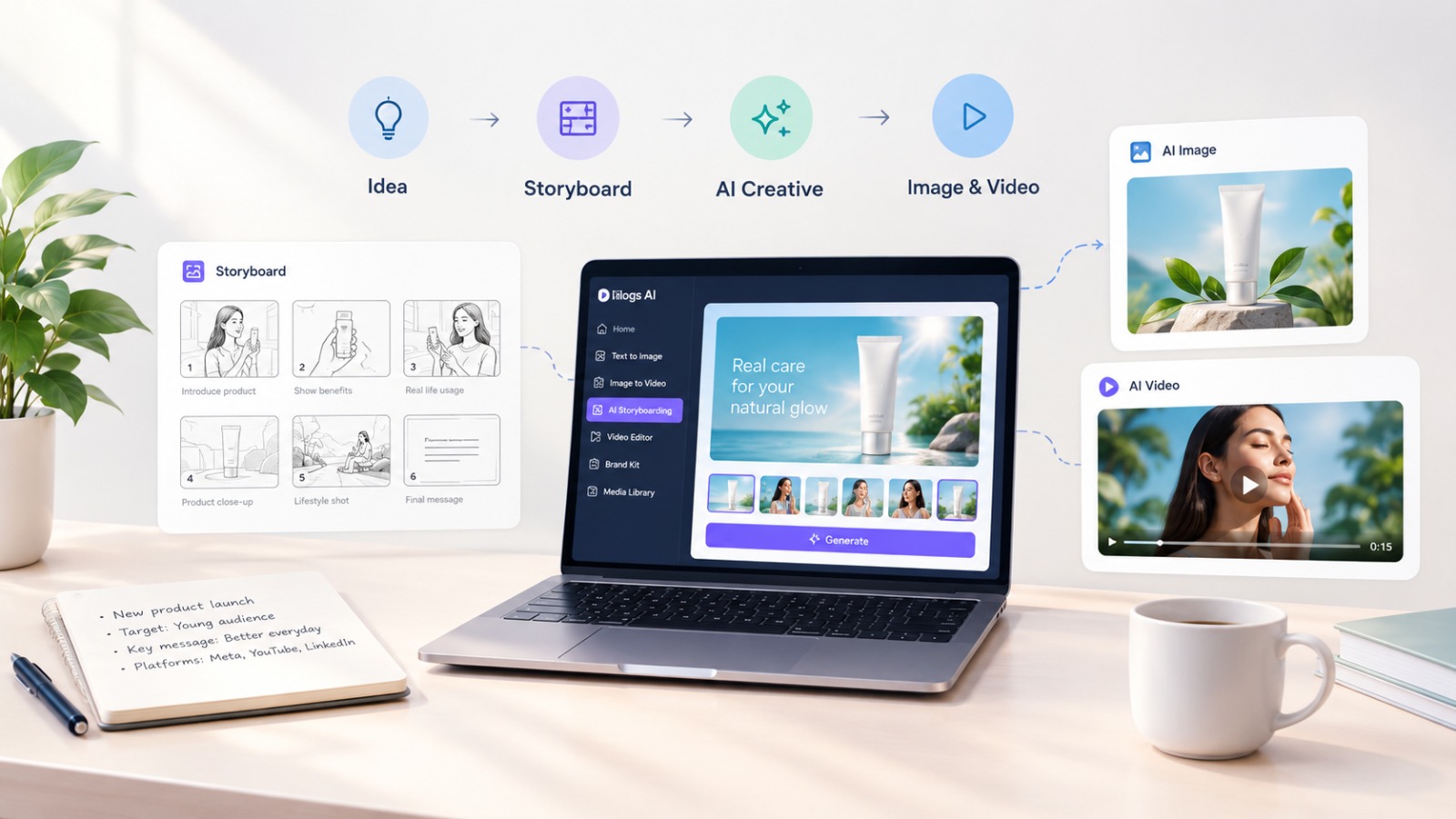
Dilogs AI helps businesses create AI-generated advertising content, including images and videos. Its workflow also emphasizes AI storyboarding, helping users plan and visualize a creative concept before generating the final asset.
A good AI content workflow should not begin with pressing a “Generate” button.
A more effective process is:
Idea → Concept → Storyboard → Creative → Review → Edit → Publish → Test
Each stage has a purpose.
First, the team defines the marketing objective. Then it develops the creative concept and determines what the content should communicate.
For video advertising, AI storyboarding can be particularly useful. A storyboard gives the team a visual preview of the planned creative before the final video is generated.
This makes it easier to identify problems early, make changes, and align the creative with the campaign objective.
Dilogs AI uses AI storyboarding to help users visualize and approve a concept before generating the final AI creative.
The process can be:
Plan the creative → Preview the storyboard → Make changes → Generate the final AI creative
This approach can reduce the risk of creating a finished video that does not match the original idea.
AI does not make traditional content creation irrelevant. The two approaches can work together.
| Factor | Traditional Content Creation | AI-Assisted Content Creation |
|---|---|---|
| Production speed | Often requires more manual steps | Can accelerate repetitive tasks |
| Creative variations | More time required for each version | Easier to explore multiple concepts |
| Cost | Can require more production resources | May reduce some production effort |
| Experimentation | Often slower to test ideas | Faster concept exploration |
| Editing | Primarily manual | AI can assist with some tasks |
| Scalability | Resources can become a limitation | Easier to produce more variations |
The right choice depends on the type of content, quality requirements, team capabilities, budget, and campaign goals.
Simply using an AI tool does not guarantee better marketing. Businesses need a clear process.
Know what the content needs to achieve before creating it.
Is the goal awareness, engagement, lead generation, product promotion, or sales?
AI-generated content should be based on a real audience and its needs.
Define who the content is for and what problem, desire, or question it should address.
Give your team clear guidelines for tone, messaging, visuals, and brand identity.
Use AI to explore concepts, create drafts, generate variations, and accelerate production.
Always check the final content for accuracy, quality, brand fit, and relevance.
AI can generate possibilities, but marketers provide context and judgment.
Create different versions when the campaign benefits from creative testing.
Track the metrics that matter to the campaign, such as engagement, clicks, conversions, or other relevant business outcomes.
Use performance data to understand what works and improve future content.
AI can speed up content production, but careless use can create new problems.
Avoid these common mistakes:
The goal should not be to create the maximum amount of content. The goal should be to create useful content that supports a business objective.
There are many AI content creation tools available, but businesses should choose based on their actual workflow rather than popularity alone.
Consider:
If your business primarily needs written content, a writing-focused platform may be enough.
If your marketing team regularly produces advertising images and videos, look for a platform that supports those formats and fits into your creative workflow.
Dilogs AI is primarily an AI Ad Generator designed to help businesses create advertising visuals and videos using AI. It is not a digital marketing agency.
One of its key differentiators is AI storyboarding.
Instead of moving directly from an idea to a finished AI video, businesses can use a more structured workflow:
Plan the creative → Preview the storyboard → Make changes → Generate the final creative
Dilogs AI supports capabilities such as:
This approach can be useful for marketing teams and businesses that need to produce advertising content while maintaining greater control over the creative process.
AI is likely to become a larger part of everyday content workflows.
Businesses will be able to explore creative concepts faster, produce more personalized content, test more variations, and use AI-assisted video production more frequently.
However, human strategy will remain important.
Understanding the customer, positioning a product, developing a strong campaign idea, protecting brand identity, and deciding what content deserves to be published are not simply production tasks.
The future is likely to be less about AI replacing creative teams and more about people and AI working together to build better content workflows.
AI content creation for businesses is the use of artificial intelligence to create or assist with marketing content such as written content, images, videos, advertising creatives, and social media assets.
Businesses can use AI for ideation, research support, drafts, images, videos, advertising concepts, content variations, and other production tasks. Human review should remain part of the process.
AI can assist with blog content, social media content, advertising creatives, images, videos, email content, promotional campaigns, and other marketing materials.
AI-generated content can be useful for marketing when it is relevant, accurate, brand-appropriate, and properly reviewed. Businesses should avoid publishing generic or unchecked AI output.
Yes. AI video tools can help businesses create advertising videos and creative variations. A structured workflow, such as storyboarding before generation, can help improve the production process.
Businesses should consider ease of use, content quality, available AI models, image and video capabilities, editing, brand consistency, collaboration, export quality, scalability, pricing, and workflow integration.
AI can automate and accelerate parts of content production, but it does not eliminate the need for human strategy, creativity, editing, brand knowledge, and decision-making.
AI content creation for businesses can make modern marketing workflows faster, more flexible, and easier to scale. Businesses can use AI to explore ideas, produce content variations, create images and videos, and support everyday marketing tasks.
But better content does not come from automation alone.
The strongest results come when businesses combine AI-powered content creation with clear objectives, audience understanding, human creativity, brand guidelines, review, and performance testing.
For businesses creating advertising content, AI storyboarding can add another important step between the idea and the final creative. It gives teams an opportunity to visualize the concept, make changes, and move into production with greater clarity.
Ready to create better advertising content faster? Try Dilogs AI and turn your creative ideas into AI-powered images and videos.
Generate the next concept
Use the AI storyboard generator, connect Dilogs in Claude and ChatGPT, or check pricing.