Dilogs LogoDILOGS
Home
How it Works
Gallery
Blog
FAQ
Home
How it Works
Gallery
Blog
FAQ
HomeBlogAI in Digital Marketing:  How It Works, Use Cases
Back to Blog
AI

AI in Digital Marketing:  How It Works, Use Cases

Sohel
May 25, 2026
7 min read
Share this article

AI in Digital Marketing:  How It Works, Use Cases

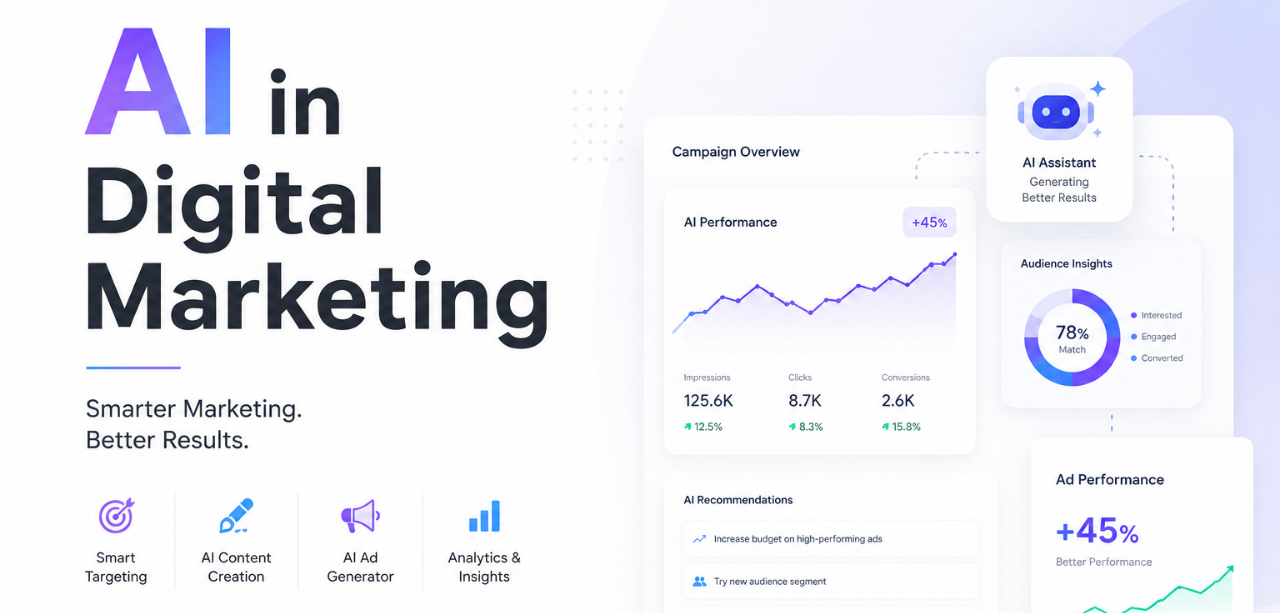
Artificial intelligence is no longer a buzzword reserved for tech giants. Today, AI in digital marketing is reshaping how businesses of every size attract customers, run campaigns, and drive revenue. From automated ad creation to hyper-personalized customer journeys, AI is quickly becoming the most powerful tool in a modern marketer’s arsenal.

If you’re a startup founder, a marketing professional, or a business owner trying to stay competitive, understanding how to leverage AI-powered marketing is no longer optional — it’s essential.


What Is AI in Digital Marketing?

AI in digital marketing refers to the use of machine learning algorithms, automation, predictive analytics, and natural language processing (NLP) to plan, execute, and optimize marketing campaigns.

In simple terms, AI helps machines learn from data, identify patterns, and make intelligent decisions — often faster and more accurately than humans can. In a marketing context, this means:

  • Machine learning that identifies which audiences are most likely to convert
  • Automation that handles repetitive tasks like email scheduling or ad bidding
  • Predictive analytics that forecast customer behavior before it happens
  • Personalization engines that serve each user uniquely relevant content

The result? Smarter campaigns, lower costs, and measurable results.


Major Benefits of AI in Digital Marketing

The adoption of AI marketing strategies is growing rapidly — and for good reason. Here’s what businesses gain:

1. Personalized Customer Experiences

AI analyzes browsing history, purchase behavior, and demographic data to deliver content tailored to each individual. Personalized experiences drive significantly higher engagement and conversion rates compared to generic messaging.

2. Better Audience Targeting

AI-powered marketing platforms can segment audiences with precision that would take human analysts weeks to achieve. Machine learning identifies micro-audiences and dynamically adjusts targeting in real time.

3. Faster Content Creation

AI content creation tools can draft blog posts, ad copy, social captions, and product descriptions in seconds. This dramatically speeds up production pipelines, especially for high-volume campaigns.

4. Improved Ad Performance

AI advertising platforms continuously test variables — headlines, visuals, calls-to-action — and automatically optimize toward the best-performing combinations. This process, known as dynamic creative optimization, removes guesswork from ad strategy.

5. Marketing Automation

From lead nurturing emails to chatbot responses, AI handles repetitive workflows without human intervention, freeing your team to focus on strategy and creativity.

6. Predictive Analytics

AI tools analyze historical data to predict future outcomes — which customers are likely to churn, which leads are ready to buy, and which campaigns will deliver the highest ROI.

7. 24/7 Customer Support

AI-powered chatbots handle customer queries around the clock, improving response times and satisfaction without increasing headcount.

8. Higher ROI, Lower Costs

Automation and precision targeting reduce wasted ad spend. Businesses using AI-powered marketing consistently report stronger returns on their marketing investments.


How Businesses Are Using AI in Marketing Today

Across industries, companies are integrating artificial intelligence in marketing in practical, revenue-driving ways:

AI-Generated Ads: Platforms like Dilogs AI allow businesses to generate professional, brand-aligned advertisements in minutes — dramatically reducing the time and cost of creative production. Instead of spending days on a single ad campaign, marketers can produce multiple variations and test them instantly.

Email Marketing Automation: AI determines the optimal send time, subject line, and content for each subscriber segment, boosting open and click-through rates.

Social Media Optimization: AI tools analyze engagement patterns and recommend the best posting times, content formats, and hashtags to maximize organic reach.

Predictive Customer Behavior Analysis: Retailers and e-commerce platforms use AI to anticipate what customers will want next, enabling proactive marketing rather than reactive responses.

AI-Powered SEO Tools: From keyword research to on-page optimization suggestions, AI tools help marketers identify content gaps and ranking opportunities faster than ever.

Programmatic Advertising: AI automates the buying and placement of digital ads in real time, targeting the right user at the right moment across millions of websites and apps.

AI Video Advertising: Emerging AI platforms now generate video content from scripts or brand briefs, making video — historically expensive — accessible to businesses at every budget level.


AI Tools Changing the Marketing Industry

The AI marketing tools landscape is expanding rapidly. Key categories include:

  • AI Ad Generators — Create compelling ad creatives automatically from brand inputs (e.g., Dilogs AI)
  • AI Design Tools — Generate on-brand visuals, banners, and social assets without a designer
  • AI Video Creators — Produce short-form video content from text prompts
  • AI Analytics Platforms — Surface actionable insights from complex marketing data
  • AI Chatbots — Automate customer support, lead qualification, and sales conversations
  • AI SEO Tools — Optimize content for search engines with data-driven recommendations

Marketers using these tools report significant time savings — in some cases reducing campaign production timelines from weeks to hours — while maintaining or improving quality.


Challenges and Limitations of AI in Marketing

AI is powerful, but it’s not without its challenges. Responsible marketers should understand the limitations:

Data Privacy Concerns: AI relies on large volumes of customer data. Businesses must ensure compliance with privacy regulations like GDPR and be transparent about how data is collected and used.

Over-Automation Risks: Automating too much can strip marketing of the authenticity that builds genuine brand relationships. Not every interaction should be machine-driven.

Dependence on Data Quality: AI is only as good as the data it learns from. Poor or biased datasets lead to inaccurate targeting and flawed predictions.

Human Creativity Still Matters: AI tools excel at optimization and scale, but breakthrough campaigns — the kind that shift culture or define a brand — still require human insight, empathy, and creative vision.

Ethical Concerns: AI-driven microtargeting and personalization raise questions about manipulation and fairness that the industry continues to navigate.

The most effective AI marketing strategies blend algorithmic power with human judgment, not one at the expense of the other.


The Future of AI in Digital Marketing

The trajectory of AI marketing strategies points toward an era of unprecedented precision and creativity:

  • Hyper-Personalized Advertising — Every ad, email, and piece of content tailored not just by segment, but by individual context and intent in real time
  • AI-Generated Video Campaigns — Full-scale video productions created from briefs in hours, not months
  • Voice Search Optimization — As voice assistants grow, AI will shape how brands appear in conversational search results
  • Predictive Customer Journeys — AI will map and anticipate every step a customer takes before they even take it
  • Real-Time Ad Optimization — Campaigns that self-adjust mid-flight based on live performance signals
  • AI-Driven Creative Production — Platforms like Dilogs AI are already at the forefront of this shift, enabling businesses to produce polished, high-performing advertising assets with a fraction of the traditional investment

The future belongs to businesses that adopt AI tools not as a shortcut, but as a strategic multiplier — amplifying human creativity and insight with machine speed and scale.


Conclusion: Why AI in Digital Marketing Is No Longer Optional

AI in digital marketing has moved from experimental to essential. Businesses that integrate AI-powered marketing into their strategies benefit from smarter targeting, faster execution, lower costs, and measurable competitive advantages.

The question is no longer whether to adopt AI — it’s how quickly you can start.

Whether you’re looking to streamline your ad creation process, improve your audience targeting, or scale your content output without scaling your team, AI tools make it possible.

Ready to see what AI-powered advertising can do for your brand? Explore Dilogs AI — an AI-powered advertising and creative platform built for modern businesses that want to move faster, spend smarter, and grow bigger.


Other Top Blogs

How Samsung Uses AIGemini vs ChatGPT
Gemini vs CopilotAdidas Uses AI
What is AI in Marketing?How Nike is Using AI
AI Instagram Ad GeneratorsWhat is Video Marketing?
What is Generative Motion?AI In Advertising
Dilogs LogoDILOGS

Transform your static images into captivating videos with the power of AI. Create, share, and inspire with Dilogs

Quick Links

  • Home
  • How it Works
  • Gallery
  • Blog
  • FAQ

Legal & Policies

  • About Us
  • Privacy Policy
  • Refund & Cancellation
  • Terms & Conditions

Contact

Dilogs AI Pvt Ltd

B1/A19, 3rd Floor, Mohan Cooperative Industrial Estate, New Delhi 110044
info@dilogs.com

Ready to transform your images?

Contact Us Now

© 2026 Dilogs. All rights reserved.

About UsPrivacy PolicyRefund & CancellationTerms & Conditions