How AI in Film Will Change the Entertainment Industry Forever
Sohel
April 22, 2026
7 min read
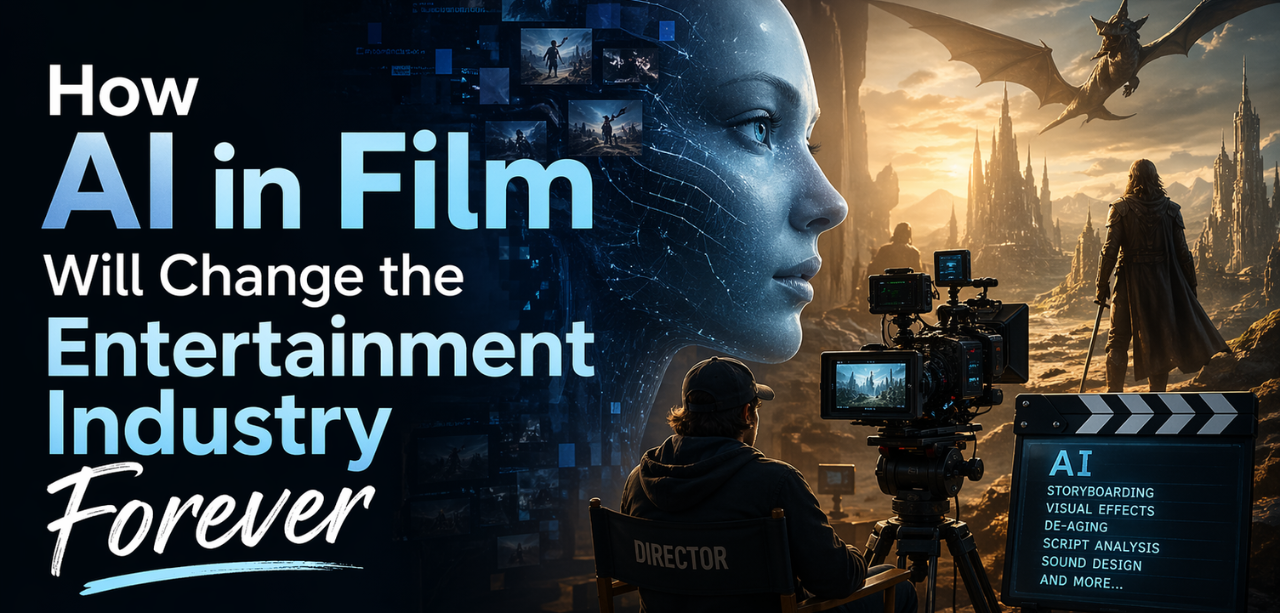
Filmmaking has always been driven by technology. Sound replaced silence. Color replaced black and white. Digital replaced celluloid. Each shift was disruptive and permanent. Today, AI in film is driving the next great transformation, moving faster than anything before it.
This is not speculation. Artificial intelligence is already embedded in the workflows of major Hollywood studios, independent production houses, and streaming platforms worldwide. According to Grand View Research, the global AI in filmmaking market was valued at $3.24 billion in 2024 and is projected to grow at 25.4% annually, reaching $23.54 billion by 2033. AI is not a passing experiment in Hollywood. It is becoming structural.
AI in film refers to the use of machine learning, generative models, and neural networks across every stage of filmmaking, from script development to distribution. Unlike traditional software, AI can analyze vast datasets, identify patterns, and generate original outputs.
Adoption has been rapid. Approximately 70% of movies now integrate some form of AI technology during production, according to WorldMetrics industry data. Real-world uses already in place include automated scene assembly, AI-generated visuals, script analysis tools, voice cloning, and audio restoration.
AI tools can now generate story ideas, suggest dialogue, analyze pacing, and predict audience response using pattern analysis of past releases. Platforms like ChatGPT, Claude, and Jasper are already used in development, while tools like Final Draft and Celtx are integrating analytics directly into the screenwriting workflow.
The data reveals an important tension. A March 2024 Variety survey found 70% of U.S. consumers prefer human-written content over AI-generated material. Yet 22% said AI could write more engaging stories, rising to 30% among millennials. AI is most valuable as a creative assistant, not a replacement author.
Post-production has historically been the most expensive and time-consuming phase of filmmaking. AI is changing that with measurable results. According to Vitrina.ai, AI dubbing now costs 60–80% less than traditional localization, while rotoscoping, once a weeks-long manual task, sees 30–40% cost reductions with AI-assisted tools.
Key tools already in professional use include Adobe Premiere Pro with Firefly (which integrated AI-powered shot extension and object removal in April 2024, with added support for Runway and OpenAI’s Sora), iZotope RX (the industry standard for AI audio cleanup), and DaVinci Resolve’s Neural Engine (offering AI-powered color matching and scene detection on a one-time purchase accessible to independent filmmakers).
AI-generated music and sound effects adoption rose from 12.5% of productions in 2023 to over 50% in 2024–2025, according to MIT AI Film Hack survey data, a sign of how quickly generative AI has moved from novelty to standard practice.
The landmark production example is Robert Zemeckis’s Here (2024), in which AI company Metaphysic.ai applied real-time deepfake de-aging to Tom Hanks and Robin Wright on set, through the camera, while shooting. This eliminated months of post-production VFX and dispensed with prosthetic makeup entirely. Indiana Jones and the Dial of Destiny (2023) similarly used AI to render Harrison Ford 30 years younger, faster, and cheaper than traditional pipelines.
Voice AI company Respeecher created all dialogue and singing for the animated chimpanzee representing Robbie Williams in Better Man (2024), and reconstructed Ernest Shackleton’s voice from 1914 wax cylinder recordings for the National Geographic documentary Endurance, bringing a voice from the silent film era back to audible life.
The most contested AI application in film is the creation of digital replicas of real actors inserted into scenes they never shot, or entirely synthetic performers generated without a human performer at all.
The industry confronted this directly when SAG-AFTRA launched its strike on July 14, 2023, a walkout lasting 118 days, the longest actors’ strike against Hollywood studios in history. AI was a central issue throughout. The resulting agreement, ratified December 5, 2023, established that studios must give performers 48 hours’ written notice before capturing their likeness and obtain explicit consent before any digital replica is used.
Critics noted the contract’s limitations: remedies for violations are “limited to monetary damages,” meaning studios could pay compensation and continue using an actor’s data rather than delete it. SAG-AFTRA’s chief negotiator Duncan Crabtree-Ireland acknowledged the unresolved questions around fully synthetic AI performer characters generated without any corresponding human: “What does that mean? How does that affect jobs? How does that affect fair compensation?”
When applied responsibly, AI delivers concrete advantages across the production pipeline:
The broader reach of the AI in the entertainment industry is illustrated by Vue Cinemas CEO Tim Richards, who confirmed in 2024 that every programming decision across the cinema chain is now made by AI, a signal that the technology has penetrated exhibition, not just production.
The risks are real. Job displacement is the most immediate concern, as rotoscoping, dubbing, crowd augmentation, and audio cleanup are all being partially automated, directly threatening roles that currently employ thousands of professionals.
Copyright disputes are active and unresolved. Disney and Universal filed suit against AI firm Midjourney in June 2025 over training data that included copyrighted material. Lionsgate and Imagine Entertainment have responded by building proprietary AI models trained only on licensed content, a model that may become the industry standard.
Deepfake misuse extends beyond studios. In October 2023, Tom Hanks publicly warned fans after an AI-generated version of him appeared promoting a dental plan without his consent, a reminder that the same technology powering creative VFX can be easily weaponized outside the studio system.
The institutional signals are unambiguous. In April 2025, the Academy of Motion Picture Arts and Sciences ruled that AI-made films are eligible for Oscar nominations, formally accepting AI as part of the creative process while indicating a preference for productions with significant human involvement. In May 2025, Toei Animation, the studio behind One Piece and Dragon Ball, announced AI integration across drawing assistance, motion generation, and background design in its production pipeline.
Looking ahead, the AI in the entertainment industry is moving toward real-time on-set rendering, personalized adaptive viewing, interactive storytelling, and fully AI-generated features. McKinsey projects mass AI adoption could redistribute up to $60 billion in annual industry revenue within five years disruption on a scale comparable to the shift from linear television to streaming.
The transition is happening regardless. The practical steps are clear: learn the tools through hands-on use rather than theory; experiment on lower-stakes projects before AI becomes essential in high-budget productions; invest in what AI cannot replace emotional authenticity, cultural specificity, and genuinely surprising creative decisions; and understand the legal landscape, since rights clearance and consent documentation are now prerequisites for any production using AI-generated content or digital likeness.
AI is not replacing filmmakers. It is changing how films are made, compressing timelines, lowering costs, and opening new creative possibilities, while introducing real risks that the industry is still working to manage.
The evidence is settled. AI in film is growing at over 25% annually. Major studios are building proprietary AI systems. Union contracts now contain AI provisions. The Academy has ruled on eligibility. The infrastructure of cinema is changing at every level.
What will not change is the value of a story told with genuine human insight. The filmmakers who shape what comes next will be those who embrace the new tools without losing sight of what only they can bring to the work.