AI Video Ads vs Traditional Video Ads: Which Wins in 2026?
Sohel
May 27, 2026
9 min read
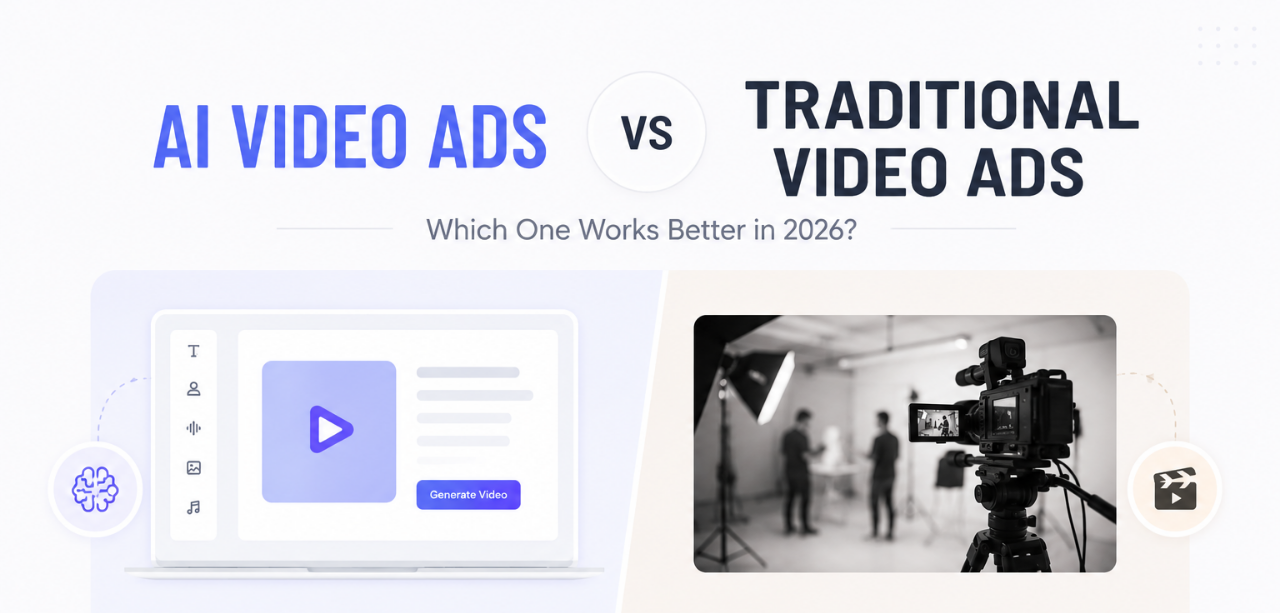
Video advertising in India has never moved faster. Just a few years ago, producing a compelling video ad meant booking a studio in Mumbai or Delhi, hiring actors, assembling a production crew, and spending weeks in post-production — often burning through lakhs of rupees before a single frame went live. Today, AI-powered tools can generate a polished, platform-ready video ad in minutes, at a fraction of that cost.
As Indian brands compete for shrinking attention spans across Instagram Reels, YouTube, and OTT platforms, the debate around AI video ads vs traditional video ads has never been more relevant. Whether you’re a D2C startup in Bengaluru, an ecommerce seller on Meesho or Flipkart, or an established brand refining your media mix — understanding both approaches can sharpen your entire advertising strategy.
Traditional video ads are produced through a conventional filmmaking pipeline. The process typically involves:
In India, brands have long relied on advertising agencies and production houses — from big names like Ogilvy and McCann to hundreds of regional studios — to deliver TV commercials and premium social media content. A 30-second TV commercial from a mid-tier Indian agency can easily cost ₹5 lakh to ₹50 lakh or more, and production timelines of four to ten weeks are common. Even social media video campaigns produced the traditional way require meaningful investment.
The output, however, can be stunning — emotionally resonant storytelling, cinematic visuals, and brand films that stay in the viewer’s memory long after the ad ends.
AI video ads use automation and machine learning to generate video content with minimal human production effort. Modern AI ad platforms can handle:
Platforms like Dilogs AI are at the forefront of this shift, enabling Indian businesses to generate professional-quality video ads without a single camera or editor on staff. Brands can create, test, and launch campaigns in a fraction of the time and budget that traditional production demands — a massive advantage in a market as fast-moving and price-sensitive as India.
| Factor | Traditional Video Ads | AI Video Ads |
|---|---|---|
| Average production cost | ₹5 lakh – ₹50 lakh+ | ₹500 – ₹5,000 per video |
| Agency/crew fees | High | None or minimal |
| Revision costs | Expensive | Negligible |
| Scaling to multiple variants | Very costly | Near zero marginal cost |
Traditional video production involves fixed and variable costs that add up quickly — studio rentals in cities like Mumbai or Hyderabad, talent fees, equipment hire, and post-production editor time. AI video ads dramatically compress these costs, making professional advertising accessible to the thousands of Indian startups and MSMEs that couldn’t previously afford quality video content.
Traditional video ad production in India typically takes 3 to 10 weeks from brief to delivery. AI video ads can be ready in minutes to a few hours, allowing marketers to react instantly to festivals, sales events like Big Billion Days, or trending moments on social media.
India’s diversity demands scale. Brands targeting audiences across Hindi, Tamil, Telugu, Malayalam, Kannada, and Bengali markets need localized content — and producing separate traditional videos for each language is prohibitively expensive. AI video advertising solves this entirely, generating regional variants with different voiceovers and on-screen text at virtually no extra cost.
Traditional video advertising excels at deep emotional storytelling — the kind of Diwali campaign or IPL-season brand film that creates cultural moments and drives massive brand recall. AI ads are better suited to rapid experimentation: testing dozens of hooks, offers, and messaging angles to find what converts for your specific audience.
AI-generated ads are inherently data-friendly. They can be built for specific conversion goals, integrated with Meta Ads Manager or Google Ads, and optimized continuously based on real campaign data. This makes them ideal for India’s performance-first digital marketing ecosystem where ROAS (Return on Ad Spend) is king.
For most growth-focused Indian businesses in 2026, AI video advertising offers compelling advantages:
This makes AI video ads especially valuable for ecommerce sellers, D2C brands, EdTech startups, fintech apps, and performance marketers across India who need to move fast and prove ROI on tight budgets.
Despite the rise of AI, traditional video production retains real strengths that Indian brands shouldn’t dismiss:
Major Indian brands — think Tanishq’s emotional jewellery campaigns, Asian Paints’ slice-of-life stories, or Fevicol’s iconic humour — use traditional production to build the kind of brand equity that no automated tool can replicate overnight.
AI video advertising isn’t without its limitations:
The best results come when AI tools are paired with experienced Indian marketers who understand local culture, consumer psychology, and platform behaviour.
Traditional production has significant drawbacks for most Indian businesses in today’s landscape:
The honest answer: it depends on your goals, budget, and growth stage.
| Business Type | Recommended Approach |
|---|---|
| D2C startup / bootstrapped brand | AI video ads |
| Ecommerce seller (Amazon, Flipkart, Meesho) | AI video ads |
| Enterprise / national brand campaign | Traditional + AI scaling |
| Social media / performance marketing | AI video ads |
| TV / OTT / premium placements | Traditional video ads |
| Regional / multilingual campaigns | AI video ads |
The smartest Indian brands in 2026 are combining both approaches: traditional production for flagship brand campaigns and emotionally resonant storytelling, and AI tools like Dilogs AI to create performance-optimized variants for Meta, Google, and YouTube — localized across languages and scaled across regions at minimal cost.
This hybrid model delivers both cultural depth and campaign velocity — the best of both worlds for the Indian market.
India is one of the world’s fastest-growing digital advertising markets, and AI is set to reshape it significantly. Key trends to watch:
With India’s internet user base exceeding 900 million and short-form video consumption exploding on platforms like YouTube Shorts, Instagram Reels, and Moj, AI-generated video ads are positioned to become the default tool for digital marketers across the country.
The AI video ads vs traditional video ads debate in India doesn’t have a single answer — but the momentum is clear. AI video ads are faster, far more affordable, and infinitely scalable, making them the practical choice for most Indian businesses navigating a competitive, mobile-first, multilingual digital landscape. Traditional video ads still hold the edge in emotional storytelling and premium brand building — but their role is evolving into one piece of a broader strategy.
For Indian businesses that want to grow in 2026 and beyond, embracing AI-powered marketing is no longer optional. Platforms like Dilogs AI make it possible for any brand — from a Bengaluru D2C startup to a regional FMCG company — to produce high-quality, platform-optimized video ads that drive real results, without the lakh-rupee production bills.
Ready to transform your video advertising? Explore Dilogs AI and create your first AI-powered video ad today.