Different Kinds of Ads You Need to Know About
Sohel
May 4, 2026
10 min read
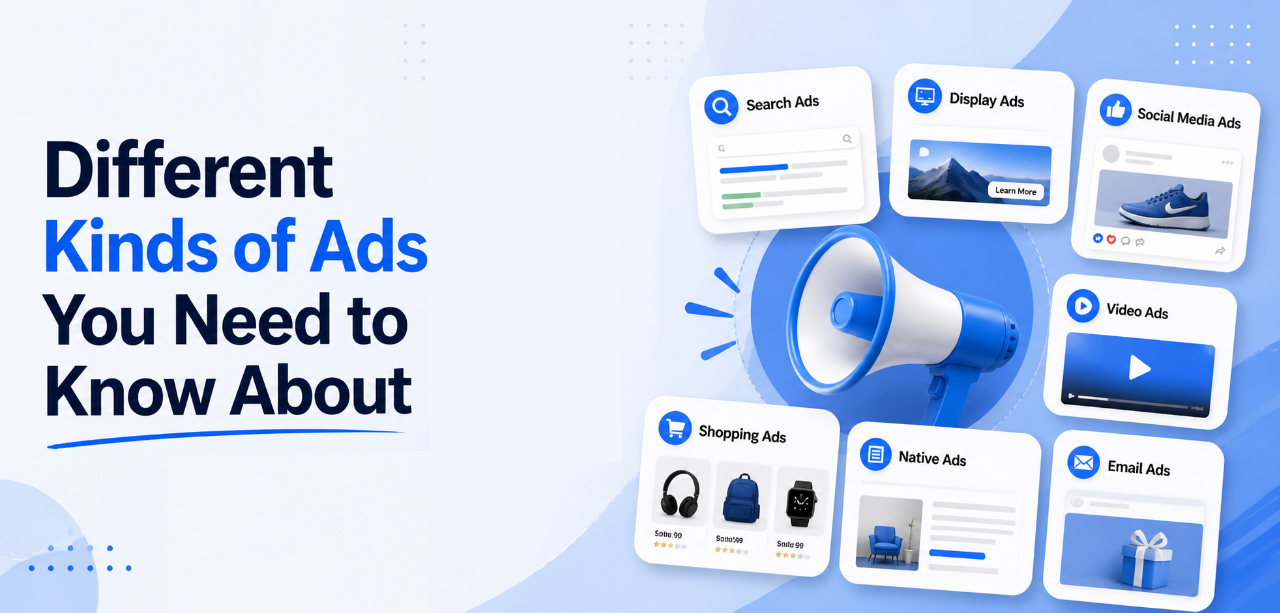
Every day, the average person encounters between 4,000 and 10,000 ads. They’re on your phone, your TV, your favorite website, and even the side of a bus. Yet most businesses waste significant budgets by choosing the wrong ad format for the wrong audience.
Knowing the different types of advertising helps you spend smarter, reach further, and convert better. This guide breaks down every major ad format in plain English — with real examples, honest pros and cons, and expert advice on when to use each one.
Advertising is the paid, intentional effort to communicate a message to a target audience with the goal of influencing their behaviour — whether that’s making a purchase, signing up for a service, or simply remembering a brand.
It sits at the heart of business growth. Without visibility, even the best product fails. The right ad, shown to the right person at the right time, is one of the most powerful tools in modern business.
Long before the internet, businesses relied on traditional advertising to build empires. These formats are still alive — and surprisingly effective when used correctly.
What it is: Paid video commercials broadcast on television channels.
How it works: Brands buy airtime slots during popular programming. The cost scales with viewership — a Super Bowl spot costs millions; a local cable slot costs far less.
Real-world example: Coca-Cola’s holiday TV campaigns have run for decades, creating emotional associations that outlast any single campaign.
Advantages:
Disadvantages:
Best for: National brands targeting broad, general audiences.
What it is: Audio-only commercials broadcast during radio programming.
How it works: Advertisers buy time slots on local or national stations, often targeting commuters and working adults.
Advantages: Low cost, high frequency, strong local targeting. Disadvantages: No visual component; easily tuned out.
Best for: Local businesses, event promotions, and reaching commuters.
What it is: Advertisements placed in newspapers, magazines, or brochures.
How it works: Brands purchase space within publications that align with their target readership.
Advantages: Trusted by readers, long shelf-life (especially in magazines), and niche targeting through specialist publications. Disadvantages: Declining readership, no interactivity, and slow feedback loops.
Best for: Luxury brands, B2B companies, and hyper-local businesses.
What it is: Billboards, transit ads, bus stops, and digital signage placed in public spaces.
Advantages: Impossible to skip, 24/7 visibility, and great for brand awareness. Disadvantages: No precise targeting and limited measurability.
Best for: Local brand awareness campaigns and high-footfall locations.
Digital advertising now accounts for over 70% of total global ad spend — and for good reason. It offers targeting, tracking, and scalability that traditional media simply cannot match.
What it is: Text-based ads that appear at the top of search engine results pages (SERPs).
How it works: Advertisers bid on keywords through platforms like Google Ads. You only pay when someone clicks your ad.
Real-world example: Search “best running shoes” on Google and you’ll see sponsored listings above organic results — those are PPC ads.
Advantages:
Disadvantages:
Best for: Businesses with clear purchase-intent keywords and immediate sales goals.
What it is: Visual banner ads (images, GIFs, or HTML5) that appear across websites within Google’s Display Network or similar ad networks.
How it works: Ads are shown to users based on their demographics, interests, or browsing history.
Advantages: Wide reach, visually engaging, great for brand awareness. Disadvantages: Low click-through rates (avg. 0.1%); susceptible to ad blockers.
Best for: Top-of-funnel brand awareness and retargeting campaigns.
What it is: Paid promotions that appear natively within social platforms like Meta (Facebook/Instagram), LinkedIn, X (Twitter), Pinterest, and Snapchat.
How it works: Advertisers use each platform’s ad manager to define audiences by age, interests, location, job title, and more.
Real-world example: A fitness brand running Instagram carousel ads targeting women aged 25–40 who follow yoga accounts.
Advantages:
Disadvantages:
Best for: D2C brands, e-commerce, and businesses with strong visual identities.
What it is: Promotional video content shown before, during, or alongside streaming content on YouTube, TikTok, Meta, and connected TV (CTV).
How it works: Skippable and non-skippable formats are available. Short-form (6–15 seconds) performs best for awareness; longer formats work for consideration.
Advantages: Highest engagement rate of any digital ad format; storytelling-friendly. Disadvantages: High production costs; short attention spans demand fast hooks.
Best for: Brand building, product demonstrations, and emotional storytelling.
What it is: Ads designed to blend seamlessly with the surrounding editorial content so they feel less like ads.
How it works: Native ads appear as sponsored articles, recommended content, or in-feed posts on platforms like Taboola, Outbrain, or within social feeds.
Real-world example: A sponsored article titled “5 Ways to Improve Your Sleep” placed on a health news website — written by a mattress brand.
Advantages: Less disruptive; higher engagement than display ads; builds trust. Disadvantages: Can feel deceptive if not clearly labelled.
Best for: Content-driven brands, SaaS companies, and long-funnel B2B marketing.
What it is: Partnering with individuals who have built loyal, engaged audiences to promote your product or service.
How it works: Brands collaborate with macro-influencers (1M+ followers), micro-influencers (10K–100K), or nano-influencers (<10K) depending on budget and niche.
Advantages: Authentic recommendations drive high trust and conversion. Micro-influencers often deliver better ROI than celebrities. Disadvantages: Hard to measure, brand safety risks, and variable quality.
Best for: Fashion, beauty, food, fitness, and lifestyle brands targeting Gen Z and Millennials.
What it is: Performance-based advertising where third-party publishers (affiliates) promote your product and earn a commission per sale or lead.
How it works: Affiliates share unique tracking links via blogs, newsletters, or social media. You only pay for results.
Advantages: Zero upfront risk — you pay only for conversions. Scalable with the right affiliates. Disadvantages: Brand messaging can be inconsistent; fraud is a real risk.
Best for: E-commerce, SaaS, and subscription-based businesses.
What it is: The automated, AI-driven buying and placement of digital ads in real time using data signals.
How it works: When a user loads a webpage, a lightning-fast auction occurs in milliseconds. The winning advertiser’s ad is instantly displayed — based on the user’s profile, behaviour, and bid.
Advantages: Hyper-targeted, efficient, and scalable across millions of placements simultaneously. Disadvantages: Complex setup, potential for ad fraud, and brand safety concerns.
Best for: Mid-to-large businesses running high-volume digital campaigns.
What it is: Ads shown specifically to users who have previously visited your website or app but did not convert.
How it works: A tracking pixel (e.g., Meta Pixel or Google Tag) is placed on your site. When a user leaves without buying, they begin seeing your ads across the web.
Real-world example: You browse a pair of sneakers on Adidas.com, close the tab, and then see those exact sneakers in an ad on Instagram an hour later.
Advantages: Targets warm audiences with high purchase intent; significantly higher conversion rates than cold traffic ads. Disadvantages: Can feel intrusive if overdone; frequency caps are essential.
Best for: Every e-commerce or lead-gen business. Non-negotiable for recovering abandoned carts.
What it is: Ads specifically optimised for smartphones and tablets — including in-app ads, SMS ads, push notifications, and mobile display banners.
How it works: With over 60% of web traffic coming from mobile, platforms serve ads within apps, games, and mobile browsers.
Advantages: Always-on access to consumers; location-based targeting; rich interactive formats. Disadvantages: Small screen size limits creative; intrusive formats drive app deletions.
Best for: Any brand targeting consumers under 45, especially for impulse-purchase categories.
What it is: Product-listing ads (PLAs) that display a product image, name, price, and store name directly within search results or shopping platforms.
How it works: Google Shopping Ads and Amazon Sponsored Products pull data from your product feed and display them to shoppers with high purchase intent.
Advantages: Visual, intent-driven, and directly tied to sales. One of the highest-ROI formats for e-commerce. Disadvantages: Requires a well-maintained product feed; competitive in popular categories.
Best for: Any online retailer or brand with a product catalogue.
| Ad Type | Best For | Cost Range | Measurability | Best Audience |
| TV Ads | Brand awareness | Very High | Low | Mass market |
| Radio Ads | Local reach | Low to Medium | Low | Commuters |
| Print Ads | Niche targeting | Medium to High | Low | Professionals |
| Outdoor (OOH) | Local visibility | Medium to High | Low | General public |
| Search Ads (PPC) | High intent leads | Low to Very High | Very High | Active searchers |
| Display Ads | Top-of-funnel | Very Low | Medium | Broad digital users |
| Social Media Ads | Targeted reach | Low to High | High | Demographics + interests |
| Video Ads | Storytelling | High to Very High | High | Visual learners |
| Native Ads | Trust-building | Low to High | Medium | Content consumers |
| Influencer Marketing | Community trust | Low to Very High | Medium | Niche audiences |
| Affiliate Marketing | Performance sales | Pay-per-result only | High | Existing audiences |
| Programmatic | Scale & precision | Low to Very High | High | Data-defined audiences |
| Retargeting | Conversion recovery | Very Low to Low | Very High | Past visitors |
| Mobile Ads | On-the-go users | Very Low to High | High | Mobile-first users |
| Shopping Ads | Direct sales | Low to High | Very High | Ready-to-buy shoppers |
Understanding the different types of advertising isn’t just marketing theory — it’s practical power. The brands winning in 2025 aren’t necessarily the ones with the biggest budgets. They’re the ones who know which ad to run, where, when, and why.
From traditional TV spots to AI-powered programmatic campaigns, every format has a purpose. The key is aligning your goals, audience, and budget with the right format — then executing with precision and measuring everything.
Your next step? Audit your current ad strategy. Are you using the right types of ads for where your customer is in their journey? If not, now you know exactly where to start.
The best ad isn’t the flashiest one. It’s the one that reaches the right person with the right message at the right moment.