How Samsung Uses AI
Sohel
March 5, 2026
7 min read
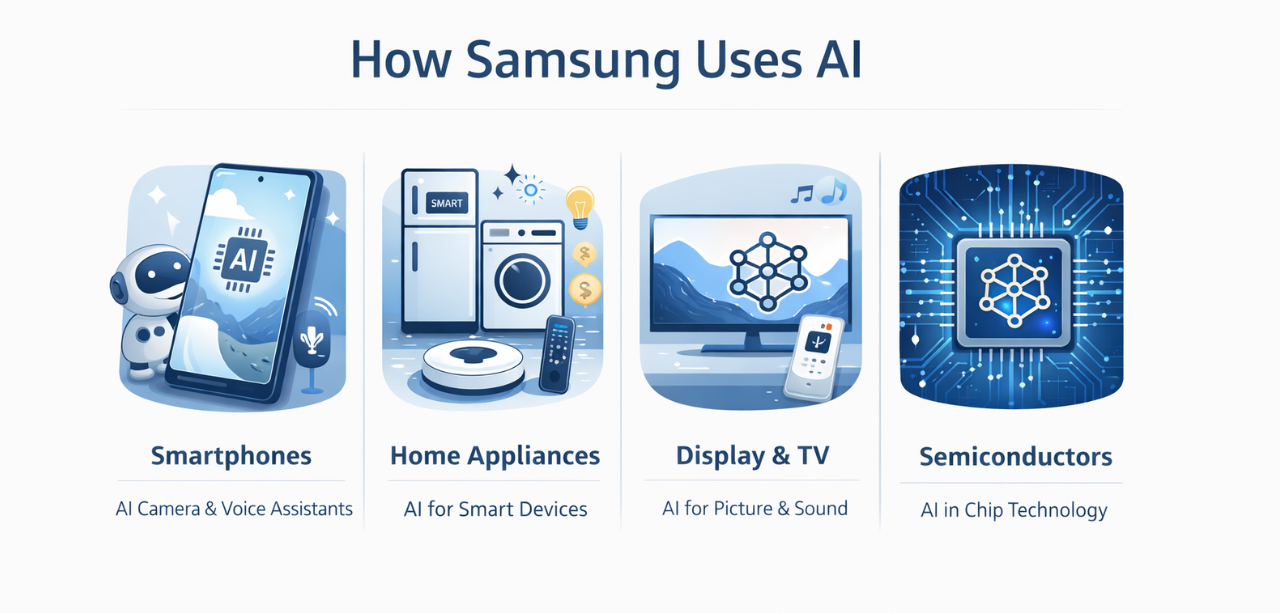
Artificial intelligence is no longer a futuristic concept — it’s quietly running inside the devices you use every single day. From the phone in your pocket to the refrigerator in your kitchen, AI is reshaping how technology works. And few companies are pushing that transformation harder than Samsung. Samsung uses AI across nearly its entire product lineup, embedding intelligent features into smartphones, televisions, home appliances, and beyond. This article breaks down exactly how — and why it matters.
When we say Samsung uses AI, we mean the company has built machine learning algorithms, neural processing chips, and smart software directly into its hardware and services. Rather than being a single feature, Samsung AI technology is a layered system — working behind the scenes to learn your habits, optimize performance, and make devices more responsive to real human needs.
Samsung’s AI strategy operates across three levels:
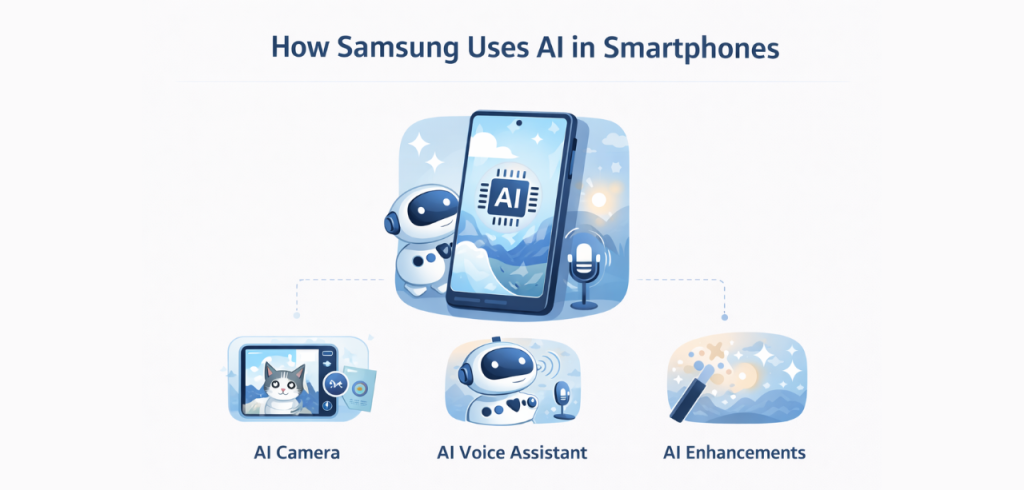
The camera is where most users first notice AI in Samsung phones. On Galaxy devices, AI analyzes your scene in real time — detecting whether you’re shooting food, a landscape, a pet, or a person — and automatically adjusts color, contrast, sharpness, and exposure. The result? Better photos with less effort.
Features like Nightography use AI to brighten low-light images without introducing grainy noise. The Generative Edit tool, introduced on Galaxy S24, lets users remove objects, reposition subjects, or fill backgrounds using on-device generative AI.
Samsung’s Adaptive Battery feature uses AI to study which apps you use most, when you use them, and how much power they consume. Over time, it restricts background activity for apps you rarely open — extending battery life without you lifting a finger.
The processor itself, Samsung’s Exynos and Snapdragon-powered chipsets, includes a dedicated Neural Processing Unit (NPU) that handles AI tasks locally — faster and more privately than cloud-based alternatives.
Bixby, Samsung’s voice assistant, uses natural language AI to understand commands, control device settings, and integrate with third-party apps. On newer Galaxy devices, Samsung has also partnered with Google to bring Gemini AI deeper into the Android experience, giving users access to generative AI directly from their lock screen.
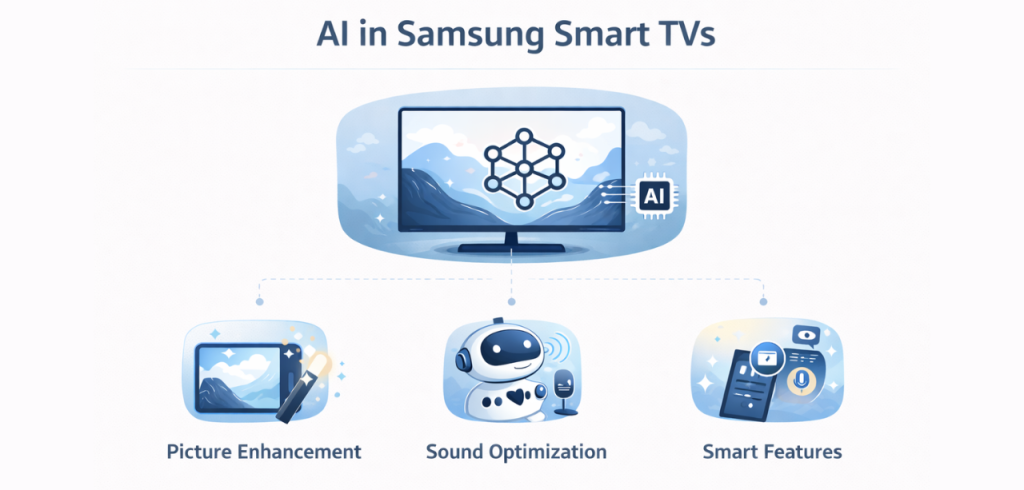
Samsung’s QLED and Neo QLED televisions use a processor called the Neural Quantum Processor, powered by AI. It upscales lower-resolution content to near-4K or 8K quality in real time by analyzing and filling in visual detail.
The AI Sound feature analyzes what you’re watching and adjusts audio accordingly — boosting dialogue during a drama, expanding soundstage during an action sequence, and optimizing bass during a concert.
Samsung Smart TVs learn what you watch, when you watch it, and how long you stay on a channel. The home screen evolves over time, surfacing content you’re more likely to enjoy across streaming platforms — all powered by on-device behavioral AI.
SmartThings is Samsung’s connected home platform, and AI is at its core. It connects compatible devices — lights, locks, thermostats, washing machines, TVs — and uses AI to automate routines based on your behavior.
For example, SmartThings can learn that you usually leave for work at 8:00 AM and automatically adjust your thermostat, lock your doors, and turn off lights — without you setting anything up manually.
Samsung’s Home Hub devices can act as a central controller for your entire smart home. They use AI to recognize routines, suggest automations, and even predict when you’ll need certain devices to be active — reducing energy waste and improving convenience.
Samsung’s AI Wash feature detects the weight and fabric type of your laundry load. It then automatically selects the appropriate wash cycle, water level, and spin speed. Over time, it learns your laundry preferences and optimizes accordingly.
The Samsung Family Hub refrigerator includes an internal camera and AI software that identifies the food inside, tracks expiration dates, and suggests recipes based on what’s available. It can even place grocery orders automatically when supplies run low.
Across appliances, Samsung’s AI Energy Mode monitors usage patterns and shifts power consumption to off-peak hours — saving electricity costs and reducing environmental impact.
Samsung isn’t slowing down. The company has outlined a bold roadmap for Samsung AI innovation that includes:
Samsung has publicly committed to making AI a core part of every major product category by 2026 and beyond.
For consumers, Samsung’s AI approach means smarter devices that require less manual configuration. For businesses and developers, it means a robust ecosystem to build on. And for the broader tech industry, it sets a benchmark for how AI can be embedded meaningfully into hardware — not just added as a marketing feature.
Samsung artificial intelligence features are designed around one central idea: technology should adapt to people, not the other way around. When your phone knows your shooting style, your TV learns your taste, and your refrigerator tracks your groceries, the experience becomes genuinely personal.
Samsung uses AI not as a gimmick, but as a foundation. From the camera algorithms on the Galaxy S series to the energy-saving systems in smart appliances, artificial intelligence is woven into the Samsung experience at every level. As on-device AI becomes more powerful and Samsung’s ecosystem grows tighter, these features will only become smarter, faster, and more intuitive. Whether you’re a tech enthusiast, a busy household manager, or simply someone who wants their devices to work better — Samsung’s AI-driven products are already making that happen.
READ ALSO:- How Adidas Uses AI to Scale Performance Marketing Globally
Q1: What does Samsung use AI for?
Ans: Samsung uses AI to enhance cameras, optimize battery life, personalize content on Smart TVs, automate smart home routines, and improve the performance of home appliances like washing machines and refrigerators. AI is embedded across nearly every product category Samsung offers.
Q2: What is Galaxy AI on Samsung phones?
Ans: Galaxy AI is Samsung’s suite of on-device and cloud-powered artificial intelligence features available on Galaxy smartphones. It includes tools like Generative Edit for photos, Live Translate for real-time call translation, and Note Assist for AI-powered summarization.
Q3: Does Samsung use AI in its home appliances?
Ans: Yes. Samsung appliances like the Family Hub refrigerator and AI Wash washing machines use machine learning to detect usage patterns, optimize energy consumption, and personalize settings based on user habits over time.
Q4: How does Samsung AI compare to Apple’s AI?
Ans: Both companies embed AI deeply into their ecosystems. Samsung’s approach leans toward cross-device integration via SmartThings and broader appliance coverage, while Apple focuses tightly on the iPhone-Mac-Watch ecosystem. Samsung also offers more hardware variety, giving its AI a wider real-world application range.
Q5: Is Samsung AI available in India and the US?
Ans: Yes. Most Samsung AI features — including Galaxy AI, SmartThings automation, and AI-powered appliances — are available in both India and the United States. Some generative AI features may require a Samsung account and internet connectivity for cloud-based processing.