The Social Media Metrics to Track in 2026
Sohel
February 17, 2026
11 min read
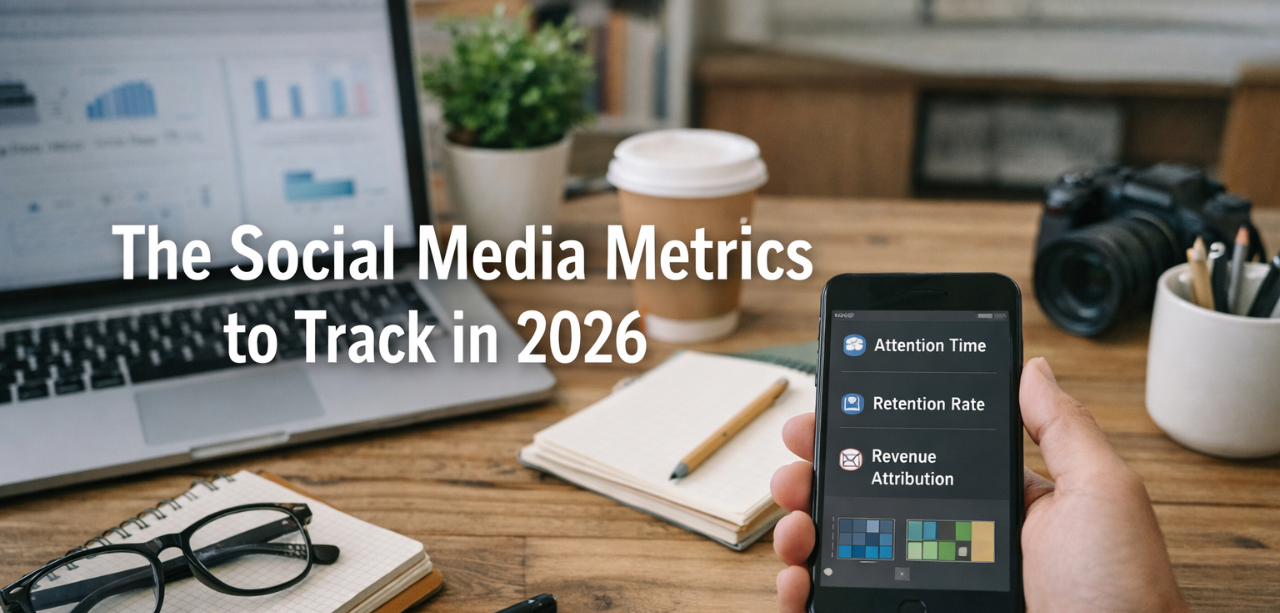
The rules of the game just changed — again.
Every year, platforms quietly shift how content gets distributed. But 2026 isn’t a quiet shift. It’s a structural overhaul. TikTok’s algorithm now prioritizes watch completion over raw reach. Instagram is penalizing low-save content. LinkedIn’s feed has become increasingly selective about what gets amplified. And across every major platform, AI-driven feeds are making decisions that no human editor would have made two years ago.
If your team is still pulling weekly reports built around follower growth and impressions, you’re flying with an outdated map.
The social media metrics that guided strategy in 2022 or even 2024 are losing their signal value fast. What replaces them isn’t more complexity — it’s more precision. This article breaks down exactly which engagement metrics in 2026 will tell you the truth about your content, your audience, and your revenue.
Let’s get into it.
Three forces are rewriting the measurement playbook right now.
AI-driven feeds have decoupled reach from relevance. Platforms no longer show content chronologically or even primarily to your followers. Algorithmic amplification is based on behavioral signals — how long someone watched, whether they shared it to a DM, whether it sparked a reply thread. This means a post can reach 50,000 people and generate zero business value, or reach 3,000 people and drive $40,000 in pipeline.
Personalization has fragmented the audience. Two people following the same brand account are seeing dramatically different content from that brand. What resonates with one micro-segment may fall flat with another. This makes aggregate metrics less meaningful and audience-specific performance data far more valuable.
Vanity metrics have hit a credibility wall. Founders and CMOs have gotten burned too many times by inflated follower counts and engagement pods. Boards are asking harder questions. Budget justification now requires metrics that connect to revenue, retention, or brand equity — not numbers that look impressive on a slide deck.
The shift isn’t just philosophical. It’s practical. Marketers who adapt their measurement frameworks now will have a significant analytical edge heading into the back half of the decade.
A view is a blink. Attention time is actual interest.
Platforms are increasingly surfacing data on how long users genuinely engaged with a piece of content — not just whether the autoplay counted as a view. In 2026, attention time per post gives you a far more honest picture of content quality than view count alone.
How to measure it: Use native platform analytics (TikTok’s average watch time, YouTube’s audience retention graph, LinkedIn’s dwell time indicators) and third-party tools that aggregate session-level data.
Business impact: High attention time signals content worth amplifying. It also predicts shareability more reliably than likes.
This is one of the most underused audience retention metrics in most marketing dashboards.
Retention rate measures what percentage of viewers watched, read, or stayed through your content to completion — or to a meaningful midpoint. It’s the clearest signal of whether your content is actually delivering value or just generating passive scrolls.
How to measure it: Video retention is available natively on YouTube, TikTok, and Instagram Reels. For written content, scroll depth tools like Hotjar or built-in CMS analytics give you comparable data.
Business impact: A high retention rate means your audience finds your content worth finishing. That trust compounds into brand equity over time.
Saves are the quiet currency of content performance signals.
When someone saves your post, they’re telling the algorithm — and you — that this content has lasting value. When they share it, they’re endorsing it publicly. Both actions require more intent than a double-tap.
How to measure it: Track saves-to-impressions ratio and shares-to-impressions ratio separately. A high saves ratio often predicts future search traffic and return visits.
Business impact: Content with a strong saves and shares ratio tends to have longer shelf life and broader organic reach. It’s a better predictor of compounding ROI than raw engagement rate.
Engagement isn’t just about volume — it’s about what kind of conversation your content starts.
Conversation depth looks at the quality and length of comment threads. Are people asking follow-up questions? Are they tagging others? Are your replies generating second and third-level responses?
How to measure it: Most native analytics platforms show comment count, but you’ll need to manually audit or use a social listening tool to assess depth and sentiment.
Business impact: Deep conversations signal strong community connection, which is a leading indicator of loyalty, advocacy, and long-term customer retention.
This is the metric most brands want but few have actually built.
Revenue attribution tracks which specific posts, campaigns, or content formats drove measurable business outcomes — link clicks that converted, coupon code usage, direct messages that turned into sales calls.
How to measure it: UTM parameters, platform-native conversion tracking, and CRM integrations are the foundation. Multi-touch attribution models are becoming more accessible through tools built for mid-market teams.
Business impact: When you can show that a specific piece of content drove $X in revenue, you’ve moved from a cost center to a profit center conversation with leadership.
Follower growth is a lagging indicator. Community growth quality is what actually matters.
This metric looks at who is joining your audience — are they your target customer profile? Are new followers engaging within their first 30 days? What’s the ratio of active community members to passive ones?
How to measure it: Segment new followers by engagement behavior within 30 and 60 days of following. Track what percentage of new followers take a meaningful action (comment, share, click) in that window.
Business impact: A smaller, high-quality community consistently outperforms a large, passive one in every downstream metric from conversion rate to customer lifetime value.
This one is new — and it matters more than most marketers realize.
AI amplification signals are the behavioral cues that cause platform algorithms to push content beyond your existing audience. These include early engagement velocity, save rate in the first hour, share-to-DM behavior, and repost patterns.
Understanding these signals requires more than manual reporting. Increasingly, brands are using AI-driven analytics platforms to detect early performance patterns and adjust distribution strategy in real time. Tools like dilogs.ai are part of this shift — helping teams create high-engagement content while surfacing performance insights that align with algorithmic amplification signals.
Business impact: Understanding what triggers AI amplification lets you engineer content for reach rather than hoping for it.
Consistency isn’t just good discipline — it’s an algorithmic advantage.
Content velocity measures how quickly your team can ideate, produce, and publish high-quality content without sacrificing performance. In 2026, platforms reward consistent publishers with preferential distribution.
How to measure it: Track publish cadence against engagement benchmarks. Are you maintaining quality at volume? Or does quality drop when output increases?
Business impact: Brands that can sustain high content velocity with strong performance signals build a compounding distribution advantage over slower competitors.
Based on platform updates and industry trends, more social analytics tools are now offering predictive engagement scoring — AI-generated forecasts of how a piece of content will perform before it’s published, based on historical data and current audience behavior patterns.
How to measure it: Available through AI-powered analytics platforms that analyze your content library and audience response patterns to generate pre-publish scores.
Business impact: Predictive engagement reduces content waste, improves resource allocation, and gives creative teams data-backed direction without stifling creativity.
Let’s be direct about what to stop over-indexing on.
Follower count is increasingly meaningless as a performance indicator. Algorithmic reach is determined by content quality, not audience size. A brand with 8,000 highly engaged followers can consistently outperform one with 800,000 passive ones.
Raw impressions tell you how many times your content appeared on a screen. They say nothing about whether anyone actually saw it, processed it, or cared. As attention time data becomes more widely available, impressions will feel increasingly hollow.
Basic likes are the most gamed, most reflexive, and least informative metric on any platform. They correlate weakly with purchase intent, brand recall, or any meaningful business outcome. Track them if you want, but don’t let them drive decisions.
AI social media analytics is no longer a feature — it’s becoming the operating system for content strategy.
Predictive performance modeling lets teams know, before publishing, which content formats, hooks, and topics are likely to resonate with specific audience segments. This replaces the post-and-pray approach with a test-informed publishing strategy.
Content optimization engines can analyze top-performing posts, identify the structural patterns behind their success, and generate recommendations for future content. This shortens the feedback loop from weeks to hours.
Automated reporting is freeing analysts from manual data pulls and letting them spend more time on interpretation and strategy. According to industry trends, teams using automated social reporting are reallocating significant time toward creative testing and audience analysis.
Platforms like dilogs.ai are part of this emerging category — tools built to help brands create more engaging content and surface performance insights without requiring a data science team to interpret the results. These platforms are making sophisticated analytics more accessible to lean marketing teams.
The broader takeaway: AI doesn’t replace the strategist. It gives the strategist better information, faster.
Start by auditing your current reporting stack. If your weekly social report is built around metrics that don’t connect to business outcomes, rebuild it.
Map your metrics to business goals. Awareness campaigns should prioritize attention time and AI amplification signals. Conversion campaigns should center revenue attribution and predictive engagement. Community-building efforts should track conversation depth and community growth quality.
Invest in integration. The most valuable analytics come from connecting your social data to your CRM, your website behavior data, and your sales pipeline. Silos produce vanity metrics. Integration produces business intelligence.
Train your team to ask better questions. Not “How many impressions did we get?” but “What did this content cause people to do, feel, or believe?” That reframe changes everything downstream.
Q: What are the most important social media metrics in 2026?
The most important social media metrics in 2026 are attention time, retention rate, saves-to-shares ratio, revenue per post, conversation depth, and predictive engagement score. These metrics connect directly to business outcomes rather than surface-level visibility.
Q: Are likes still important?
Ans: Likes are a low-signal metric. They can provide a baseline pulse check, but they correlate poorly with purchase intent, loyalty, or revenue. In 2026, they should be deprioritized in favor of saves, shares, and conversation depth.
Q: How do you measure engagement quality?
Ans: Engagement quality is measured by looking at the type and depth of interactions — comment length, conversation threads, saves, shares to DMs, and whether engaged users match your target customer profile. High volume with low quality is often worse than low volume with high quality.
Q: What role does AI play in social media analytics?
Ans: AI plays three primary roles: predictive performance forecasting before content is published, real-time content optimization based on behavioral signals, and automated reporting that frees teams to focus on strategy. AI-driven analytics is shifting social media measurement from reactive to proactive.
Q: What is a good retention rate for social media content?
Ans: Retention rates vary by format. For short-form video (under 60 seconds), retaining 70% or more of viewers to completion is strong. For long-form content, a 40–50% midpoint retention rate indicates solid audience interest. Benchmarks vary by industry and platform, so always compare against your own historical baseline first.
The brands that win in 2026 won’t be the ones with the biggest follower counts or the highest impression numbers. They’ll be the ones who built measurement frameworks around what actually moves the business — attention, retention, conversation, and revenue.
Social media metrics are getting smarter because platforms are getting smarter. The algorithms are reading behavioral signals that follower counts and likes could never capture. Your reporting should do the same.
Stop optimizing for what’s easy to count. Start optimizing for what actually counts.
The shift won’t happen overnight, but the marketers who make it now will have a real and compounding advantage over those who hold onto outdated dashboards through 2026 and beyond.
The metrics are telling a better story than ever. The question is whether you’re listening to the right ones.