What Is AI Storyboarding?
Sohel
July 7, 2026
7 min read
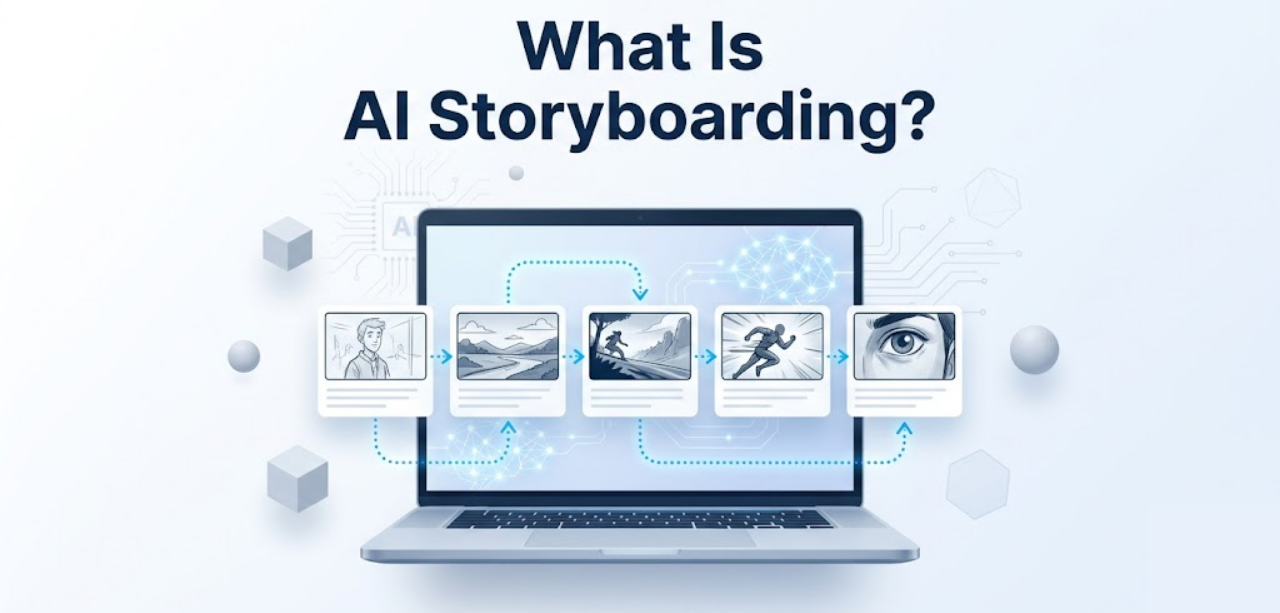
Planning a video, advertisement, or marketing campaign has traditionally meant hours of manual sketching, endless revisions, and back-and-forth between creative teams before a single frame gets filmed. For agencies and marketers working on tight deadlines, that process can feel like the biggest bottleneck in an otherwise fast-moving campaign.
This is exactly the gap that AI storyboarding is closing. By combining natural language prompts with visual generation, AI is turning what used to take days into a process that takes minutes — without sacrificing the creative direction a campaign needs. If you’ve been wondering what AI storyboarding actually is and whether it’s worth adopting, this guide breaks it down from the ground up.
AI storyboarding is the use of artificial intelligence to automatically turn an idea, script, or brief into a structured visual storyboard — a sequence of scenes that outlines how a video or ad should look and flow, frame by frame.
Traditional storyboards are drawn by hand or built manually in design software, frame by frame, usually by a trained illustrator. AI-generated storyboards, by contrast, are produced by software that reads your input text and generates scene layouts, descriptions, and visuals automatically, often in a fraction of the time.
Instead of describing a scene to an artist and waiting for a sketch, a marketer can type a short prompt and get a usable draft storyboard almost instantly. That’s why businesses of every size — from solo creators to enterprise agencies — are adopting AI-powered storyboard software as a standard part of their creative workflow.
While every tool works a little differently, most AI storyboarding platforms follow a similar core workflow:
This turns storyboarding from a purely manual craft into a guided, collaborative process — one where the AI handles the repetitive groundwork and the human team focuses on refining the creative direction.
AI storyboarding has moved from a novelty to a genuine production advantage. A few reasons it’s gaining traction across marketing and advertising teams:
Social media teams use it to plan short-form video content quickly, agencies use it to pitch concepts before committing production budget, and in-house marketing teams use it to keep campaigns moving without waiting on external creative resources.
| Factor | Traditional Storyboarding | AI Storyboarding |
|---|---|---|
| Speed | Days to complete | Minutes to a few hours |
| Cost | Higher (artists, revisions) | Lower, subscription-based |
| Manual effort | High — hand-drawn frames | Low — AI generates drafts |
| Collaboration | Slower feedback loops | Real-time, cloud-based |
| Revisions | Time-consuming redraws | Instant regeneration |
| Scalability | Limited by artist bandwidth | Scales across campaigns easily |
| Creative consistency | Varies by artist | Consistent, on-brand output |
| Ease of use | Requires drawing skill | Prompt-based, beginner-friendly |
| Automation | Minimal | High |
| Accessibility | Needs trained illustrators | Open to any team member |
AI clearly wins on speed, cost, and scalability. That said, human creativity still matters — AI is best used to accelerate the first draft, while people refine tone, story, and brand nuance.
AI storyboarding tools serve a wide range of teams, each with a slightly different use case:
Not all AI storyboarding tools are built the same. When evaluating one, look for:
Each of these directly affects how much time a team actually saves — a tool that generates fast scenes but lacks collaboration features, for instance, still creates bottlenecks further down the workflow.
Dilogs AI is a practical example of how this technology comes together in a single workflow. Instead of juggling separate tools for scripting, visualizing, and organizing scenes, creative teams can use Dilogs AI to:
Rather than replacing the creative process, Dilogs AI is built to remove the repetitive parts of it — leaving more time for the strategic and creative decisions that actually shape a campaign.
-“AI replaces creativity” — AI accelerates drafts; people still shape the story. -“AI creates perfect storyboards automatically” — output still needs human review and refinement. -“AI is only for large companies” — most tools are built for teams of any size, including freelancers. -“AI storyboards are expensive” — subscription-based tools are often cheaper than traditional production. -“AI removes the need for designers” — designers still guide tone, branding, and final polish.
AI storyboarding is still evolving quickly, and several trends are shaping where it’s headed next:
None of this suggests AI will replace creative teams — instead, it points toward AI becoming a more capable assistant throughout the entire pre-production process.
AI storyboarding is reshaping how marketers, agencies, and creative teams plan video content. It simplifies planning, saves time, reduces repetitive manual work, and makes collaboration easier across teams — all while leaving room for the human creativity that makes a campaign memorable.
If your team is still storyboarding by hand, it may be worth exploring how AI storyboarding tools like Dilogs AI can streamline that process. From your first prompt to a finished, shareable storyboard, Dilogs AI is built to help creative teams move from idea to execution faster — without losing the creative control that makes a campaign work.
| AI Instagram Ad Generators | AI Facebook Ad Generator |
|---|---|
| Gemini vs Copilot | Adidas Uses AI |
| AI Storyboard Generators | Perplexity vs ChatGPT |
Generate the next concept
Use the AI storyboard generator, connect Dilogs in Claude and ChatGPT, or check pricing.