What is Generative AI?
Sohel
October 27, 2025
13 min read
Generative AI has transformed from a specialized technology into a mainstream phenomenon that’s reshaping how we create content, solve problems, and interact with machines. Whether you’ve used ChatGPT to draft an email, DALL-E to create an image, or wondered how AI-generated music works, you’ve encountered the power of generative artificial intelligence.
This comprehensive guide explains everything you need to know about generative AI, from its fundamental concepts to real-world applications and future possibilities.
Generative AI is a subset of artificial intelligence designed to create entirely new content—including text, images, music, video, and even software code—by learning patterns from existing data. Unlike traditional AI systems that classify or analyze information, generative AI produces original outputs that closely resemble human-created content.
Traditional AI, often called discriminative AI, focuses on categorizing and analyzing data. For example, it can identify whether an email is spam or determine if a photo contains a cat. Generative AI, however, takes a creative approach by producing new content based on learned patterns and user prompts.
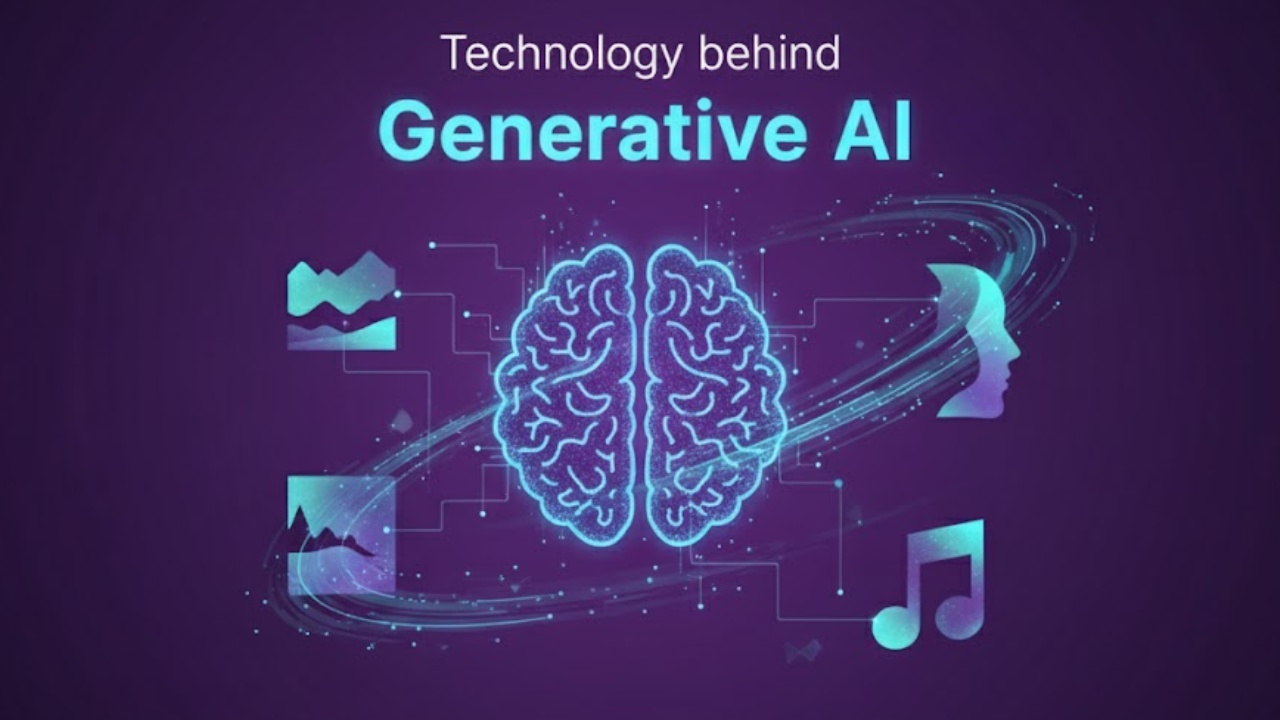
Generative AI systems undergo two critical phases:
Large Language Models (LLMs) like GPT-4, Claude, and Gemini are built on transformer architecture. They predict the next token (word or word fragment) in a sequence, enabling logical text generation for tasks ranging from conversation to code writing.
Diffusion Models Diffusion models excel at generating images and audio. They work by starting with random noise and slowly refining it through multiple denoising steps until a coherent output appears. Popular image generators like DALL-E, Stable Diffusion, and Midjourney use this approach to create photorealistic visuals from text descriptions.
Generative Adversarial Networks (GANs) GANs consist of two neural networks working in opposition: a generator creates synthetic data, while a discriminator attempts to distinguish real data from generated content. This adversarial relationship pushes the generator to produce increasingly realistic outputs. GANs have been particularly successful in image generation, though they can be challenging to train.
Variational Autoencoders (VAEs) VAEs compress data into a compact representation and then reconstruct it with variations. They’re particularly useful for tasks requiring smooth transitions between different styles or generating controlled variations of existing content.
The conceptual roots of generative AI trace back to Markov chains, developed by Russian mathematician Andrey Markov in the early 20th century. These probabilistic models could generate sequences by predicting the next element based on previous ones.
By the 1970s, artist Harold Cohen created AARON, one of the first generative AI systems for creating paintings. The 1980s and 1990s saw the emergence of generative AI planning systems used in manufacturing and military applications.
The rise of deep learning in the late 2000s provided the computational foundation for modern generative AI. In 2013, Variational Autoencoders emerged as the first deep learning models capable of generating realistic images and speech.
Generative Adversarial Networks followed in 2014, demonstrating unprecedented ability to create convincing synthetic images. These innovations proved that neural networks could be trained to generate complex, high-quality content.
Google’s introduction of the Transformer architecture in 2017 marked a turning point. The paper “Attention Is All You Need” introduced mechanisms that allowed models to process text more efficiently and understand context better than previous approaches.
This led to a rapid succession of increasingly powerful models:
-2018 : GPT-1 demonstrated the potential of generative pre-trained transformers -2019 : GPT-2 showed models could generalize to diverse tasks without specific training -2021 : DALL-E introduced high-quality AI image generation -2022 : ChatGPT’s public release brought generative AI into mainstream consciousness -2023 : GPT-4 and multimodal models expanded capabilities across text, images, and audio -2024-2025 : Claude, Gemini, and other advanced models continued pushing boundaries
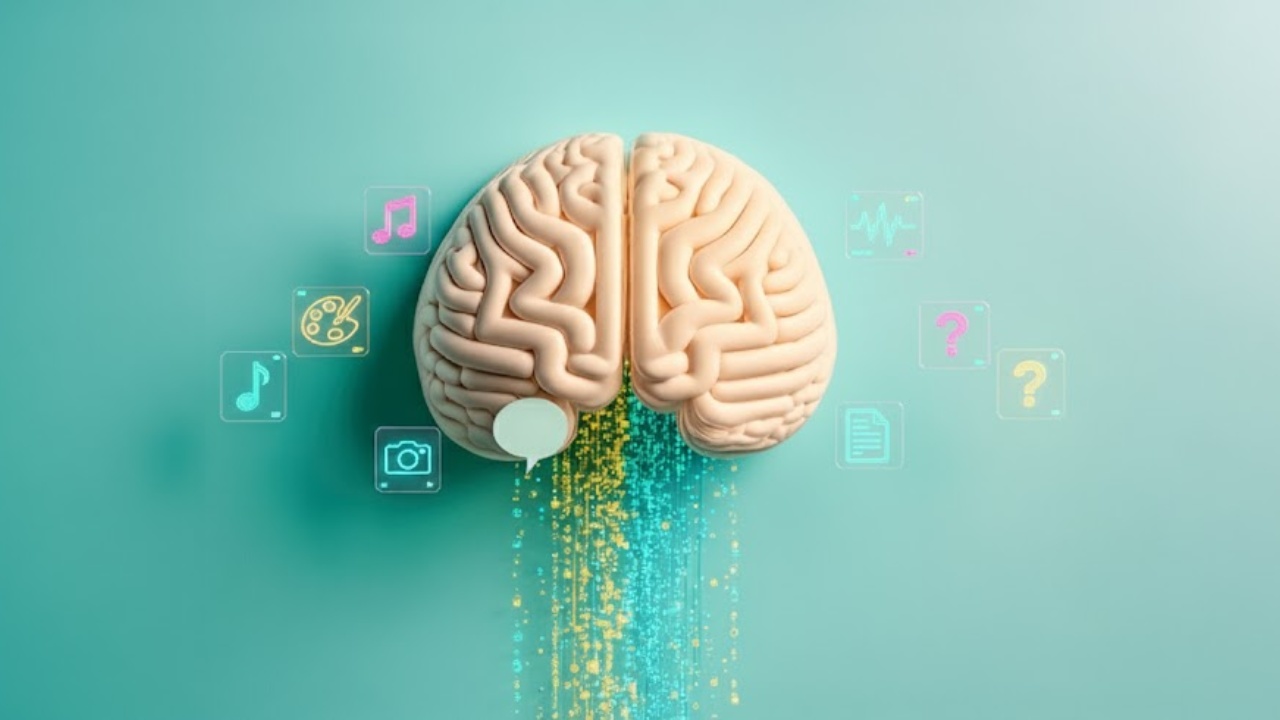
Large Language Models represent the most widely recognized category of generative AI. These systems can:
Notable examples include GPT-4, Claude, Gemini, and LLaMA. These models are trained on vast text corpora and use autoregressive prediction to generate coherent, contextually appropriate responses.
Text-to-image models transform written descriptions into visual content. They utilize techniques like:
Leading platforms include DALL-E, Midjourney, Stable Diffusion, and Adobe Firefly. These tools have democratized visual content creation, enabling users without artistic training to produce professional-quality imagery.
Generative AI can create:
Systems like ElevenLabs for voice synthesis and MusicLM for music generation demonstrate AI’s creative capabilities in the audio domain.
Text-to-video models like OpenAI’s Sora, Runway and Dilogs can generate temporally coherent video clips from text descriptions. These systems represent cutting-edge generative AI, combining understanding of motion, physics, and visual composition.
AI-powered coding assistants like GitHub Copilot, TabNine, and Cursor help developers by:
Generative AI accelerates content creation, allowing individuals and organizations to produce more in less time. Tasks that once took hours can now be completed in minutes, freeing human creativity for higher-level strategic thinking.
Professional-quality content creation is no longer limited to those with specialized skills. Anyone with a clear vision can now produce compelling visuals, write persuasive copy, or compose music using AI tools.
Generative AI enables rapid prototyping and iteration. Designers can explore hundreds of concepts quickly, researchers can test multiple hypotheses simultaneously, and entrepreneurs can validate ideas with minimal investment.
Businesses can deliver individualized experiences to millions of customers simultaneously, from personalized product recommendations to customized marketing messages that resonate with specific audiences.
Automating repetitive creative tasks reduces operational costs while maintaining or improving quality. Organizations can allocate resources to strategic initiatives rather than routine content production.
Generative AI models reflect the biases present in their training data. If training datasets contain stereotypes or underrepresent certain groups, outputs will perpetuate these issues. Addressing bias requires careful data curation and ongoing monitoring.
AI models can generate plausible-sounding but factually incorrect information, known as “hallucinations.” This poses risks in contexts requiring accuracy, such as medical advice, legal guidance, or technical documentation.
Training and running large generative models demand significant computing power, making them expensive and resource-intensive. This creates barriers for smaller organizations and raises environmental concerns about energy consumption.
The “black box” nature of complex AI models makes it difficult to understand how they arrive at specific outputs, creating challenges for accountability and trust.
Industry benchmarks like BLEU, ROUGE, and FID provide standardized ways to compare model performance across different tasks and implementations.
Dedicated tools like Bias Benchmark for QA (BBQ) and StereoSet measure whether models exhibit problematic stereotypes or unfair treatment of different groups.
Developing comprehensive guidelines for responsible AI development and deployment will be crucial. This includes:
Governments worldwide are developing regulations to govern generative AI use:
Rather than replacing humans, generative AI is evolving into a collaborative tool that augments human capabilities. The future lies in finding optimal divisions of labor where AI handles repetitive tasks while humans provide creative direction, ethical judgment, and strategic vision.
Generative AI represents one of the most transformative technologies of our time, fundamentally changing how we create, communicate, and solve problems. Its ability to generate human-quality content across multiple modalities opens unprecedented opportunities for innovation, productivity, and creativity.
However, realizing this potential requires thoughtful navigation of challenges related to accuracy, bias, ethics, and environmental impact. As generative AI continues evolving, the key to success lies in developing frameworks that maximize benefits while minimizing risks.
The future of generative AI is not just about technological advancement—it’s about shaping responsible, equitable systems that serve humanity’s best interests. Whether you’re a business leader, creative professional, developer, or curious individual, understanding generative AI is essential for participating in this transformative era.
By embracing generative AI thoughtfully and responsibly, we can harness its power to augment human creativity, solve complex problems, and build a future where technology and humanity work together to achieve what neither could accomplish alone.
Question 1: What makes generative AI different from other AI? Answer: Generative AI creates new content rather than just analyzing or classifying existing data. It can produce original text, images, music, and code based on learned patterns.
Question 2: Is generative AI replacing human creativity? Answer: No, it serves as a tool that augments human creativity rather than replacing it. Humans provide direction, judgment, and strategic vision while AI handles execution and iteration.
Question 3: How accurate is generative AI? Answer: Accuracy varies by model and task. While impressive for many applications, AI can produce hallucinations—plausible but incorrect information—making human verification essential for critical uses.
Question 4: Can generative AI be used ethically? Answer: Yes, with proper safeguards including transparent labeling, respect for intellectual property, bias mitigation, and human oversight. Responsible use requires awareness of limitations and potential harms.
Question 5: What’s the environmental impact of generative AI? Answer: Training and running large models consume significant energy and water resources. The industry is working on more efficient models and sustainable practices to reduce environmental impact.
Question 6: How will generative AI evolve in the next few years? Answer: Expect more efficient models, better multimodal capabilities, improved accuracy, enhanced user control, and comprehensive regulatory frameworks addressing ethical and legal concerns.
Generate the next concept
Use the AI storyboard generator, connect Dilogs in Claude and ChatGPT, or check pricing.